Monday, February 7, 2011

To Arusha and beyond!

Yellow Billed Stork

It was our final night in the bush.  We get our first taste of rain.  Charlie reminds us that the wildebeest take full advantage of the rain.  Their migration is following the rain in search of areas where there is water and plenty of fresh new grass upon which to graze.  It will be the area where the wildebeest will give birth.  It was surprising to hear that the mothers will hold back giving birth until the conditions in the environment are just right.
Hartebeest

The wildebeest and other animals are passing close to camp as evening draws upon us.  Patrick is thrilled to follow them off behind our tents.  We have our final night in the camp and refreshing morning sunrise.

The drive back into town continued to bring new surprises.  We pack up and head back to the main road, which will take us almost an hour to reach.  As we head out, Kevin notices swarms of insect in the road.  A quick maneuver to close up the windows was made.  However, these are not bees or other nasty beasts, they appear to be smaller than common houseflies, perhaps little gnats.

Rednecked Spurfowl

Charlie tells us that these flies come out with the rains.  The sight was amazing, there were literally many hundreds of these small funnel clouds of gnats that stood about 10 feet tall and were about 2 feet wide at the top.  We drove along the road for at least a mile passing these spiraling clouds of flies.  It was just another amazing moment of how life just springs alive with the rains.

As we reach the main road we have to retrace our steps back through the Ngorongoro conservation area, the National Park, and out again to get to Arusha.    This means, however, that we go past the Masaai, and we have hopes of seeing the young boys who are in their initiation costume.  Hooray, Mom gets here photo and the world is right!
Bibi advising her Masaai soon-to-be-Warriors
[You'll have to ask Mom about her name "Bibi".]  It is a long road and it takes us over seven hours to get back.  We head straight to the airport east of Arusha, just in time to catch our flight to Zanzibar and our next adventure.

Hunting game on the Serengeti

bat-earred fox
The evening game drive from camp was full of anticipation to fill out the last of the big five, east Africa’s five most sought after game animals: the lion, elephant, rhino, leopard and cape buffalo.  We had yet to see the leopard.  Charlie, our driver, was determined to find us a leopard, but all the while knowing that there were no guarantees. 

The great feast
Close to the shores of Lake Ndutu we saw plenty of Bat-eared foxes, families of them just poking their heads out of burrows where they shelter underground.  The guys earn their names with ears that can only conjure up images of a bat.  The dung along the road had promise of elephants in the area, but not in the last few days. 

Drying in the Sun
Next we spot our first “big kill”.  Not far along the lakeshore road we spot a large group of buzzards, mostly on the ground and a few in the air, the tell-tail sign of kill.  Nubian vultures, African white-backed vultures and Ruppell’s Griffon vultures were all busily competing and eating away at a dead wildebeest.  Clearly, the lions took their share and left a good amount for the big birds to clean up.   We were also amazed by the on-looking gallery of vultures who had already had their fair share, or, more likely, were waiting their turn to dig in.  It was quite a sight to see them all drying their wings in the mid-day sun while waiting patiently for snack time.

Heading south and west of camp we quickly found lots of Cape Buffalo, the lone Hartebeest, and plenty of interesting shore birds, including greater and lesser flamingos.  Shortly thereafter and perhaps less than a mile from camp we found a small pride of lions, complete with its leader, a male, sporting a full mane.  They were trying to sleep off the day’s earlier feast, but the tourists and their safari cars were circled around.

Quite an interesting lecture Bill!
Charlie wanted us to get a good view of the lions and so he pulled the vehicle to within about 10 feet of one of the resting lions.  Windows were opened and quickly closed, with the wonder, or should I say fear, of how fast do we need to close these windows.  We were close enough to inspect the backs of their throats during the frequent yawns, but not close enough to smell their breath.  Roberta wondered aloud to Charlie, “do they come up to the vehicle?”  Then casually Charlie replied “yes, and I’ve seen them come up and peer down into the vehicles from the open canopy”, which immediately changed the tenor of comfort in the car.  I think he enjoyed letting that one sink in.  Of course, Charlie was asked if he had ever lost a client, to which he correctly replied, “not yet”.
  
Sure feels like snack time to me.
The lions were great to watch, but we wanted to see more.  We headed further south along the stream that feeds into Lake Ndutu, where we find more wonderful birds including a majestic immature Martial Eagle (thanks to Cin-Ty Lee for the correct identification).  Coming on to the open plains of the Serengeti we begin to see Gnu or wildebeest.  Is this the migration?  But just then we see a cluster of vehicles making a hemisphere, which means only one thing: another big cat or two.  It is three cheetahs waiting and thinking about a hunt.  They keep us all in suspense, but the big news is we see for certain the spectacular migration of the wildebeest.  Yes, the horizon some distance off is filled with wildebeest.  Sadly, Charlie says that that treat is for tomorrow, and that we need to head back to camp to make it there with daylight in hand.
Martial Eagle hunting for food

Returning to camp after our evening drive gave us plenty of time to think about the closeness of the lions and what kind of sleep we had ahead of us that night.  Patrick was ready to search out the areas around camp.  Most of us were interested in relieving ourselves of some of the road dirt that covered our clothes and skin. 

The next morning we shared stories of what we heard outside our tents during the night.  Kevin and Patrick caught photos of Cape Buffalo walking some 15 to 20 yards away behind our tents in the morning quiet.  After breakfast it was off to do some more game hunting and shooting with or cameras, of course.  
Secretary Bird

The next day, a big treat


Sunset on the Serengeti

Our hopes are high for today’s safari.  We are looking forward to seeing one of the world’s true wonders, the migration of the wildebeest.  It was right where we left it last night and then some.  It is a sight that is hard to describe and even harder to capture with photographs.  There are wildebeest and zebras everywhere.  There may be a million of them, but all you can see in the immediate vicinity is only a thousand or so.  It is simply amazing.


Impala
However before we even got to the plains the morning started with a sighting of cheetahs, a mother and her two cubs.  The cubs were happily sitting together enjoying the morning air and surveying the plains.  The mother, not far off was watching her cubs and also surveying.  All was fine until we see the cubs take note.  Off in the distance there are two tourists with two game wardens taking a walking safari.  They are many hundred yards away, but the cheetahs spot them and immediately become unsettled.  Although the people are many hundreds of yards off, this fact unsettles the cheetahs, while at the same time they are surrounded by three or four vehicles, each with 3-6 people peering out at them.  As the walkers continue not even noticing the cheetahs, the cubs slink off quietly into the nearby bush.  Charlie says that they know and can predict what safari vehicles will do; people on foot are whole other story.

Cheetah cubs alert to the bush walkers
Back on the plains, where the numbers of animals are simply overwhelming, we survey the herd.  As we drive through this vast herd still in awe we find a wildebeest that is galloping with a limp and then we spot this bright red patch on the side back of his body.  He is sporting an 8-10 inch long gash in the side of him between the end of his belly and his leg.  He must have fallen victim to an attack by one of the big cats, but it was not enough to bring him down.  The future doesn’t look bright for this guy, he’ll more than likely be taken out in the coming days.
A victim of the migration with little time left...

There is more to watch on the plains, including watch those who are watching others.  We find a group of three cheetahs that are in this small sunken area with a trickle of a stream winding through.  These cheetahs are positioned in the middle of the migration pathway watching all that is happening.  While we are there, they are surrounded by a large number of curious zebras that seem to be teasing or taunting the cheetahs.  Charlie says that the cheetahs will not attack an adult zebra, they’re just too large an animal for a cheetah to bring down.  The cheetahs will, however, take out a juvenile zebra and will be forever watchful of any opportunity. 
Wildebeest leg anyone?

It has been a successful morning hunt and time to get some relief from the mid-day sun.  Even though clouds are coming in, cloudy skies on the open plains is still a challenge for even the strongest sun block.  Our trip back to camp brings us past many happy hyenas that are taking full advantage of the muddy areas created by tire tracks.  We pass by several groups, one of which was feasting on a muddy, delicious wildebeest leg, hmm good.

Agama Lizard
Our final afternoon hunt followed on the heel’s of an intense lunchtime thunderstorm. Just before the storm the air got strangely hot, so much so that several comments were made.  Then and most surprisingly, the sky unzipped and an amazing and hugely powerful thunderstorm hit covering the area quickly with rain.  And with similar speed to its arrival, it left.

A steady drizzle in the afternoon provided the right conditions for hippo viewing.  We found a crash of hippos (also referred to as a herd, dale, or bloat) soaking in the rain at the lakeshore.  These aquatic beasts were not too active, except if you call yawning an aerobic sport. 

did someone say lunch?
We went out in search of and with high hopes to find leopards and other exciting game.  We were going south along the lake areas in and out of areas where the acacia trees were slanted perfectly for easy climbing access.  These acacias offered plenty of opportunity for spotting leopards that like to position themselves up in trees surveying the area for tasty morsels.  Fourteen eyes were focused at every perch, but to no avail.

Disappointment, but that is part of life in the plains of east Africa, you get what it wants to give and enjoy the feast.

And now to the Serengeti

Our tented camp at Ngorongoro crater

Our second morning on Ngorongoro rim was again a great setting, but this morning was cloudy, offering a wonderfully different perspective on the crater and surroundings.  The elevation and partially overcast skies brought out more of the colors in the brightly clothed Masaai, who populated the road and immediate areas.  As we drove along the road we occasionally were pass by or through herds of goats and cattle. Masaai cattle are gaunt and always on the move, typically with a young herder, a boy of between about 8 and 14.  Be it goats or cattle, if they were close to or on the road or passing meant that we would send the herd scampering, creating a regrouping headache for the young Masaai boy tending.

Flamingos in the crater
Our drive brought us past nice vistas of open grasslands, crater rim views, and rugged volcanic terrain that also had surprises every few miles of small groups of giraffes and the occasional scurrying family unit of warthogs.  We were leaving the Ngorongoro highlands and heading down to the famous Serengeti plains. 
A satisfied zebra

First stop when we came off the highlands was Oldupai Gorge.  Yes, the commonly stated name “Olduvai Gorge”, made famous by Louis and Mary Leakey, is not the real name; it is Oldupai and was named after the common Massai plant oldupai, which has been used as a medicinal plant.  As the guide told us, the place is too famously recognized by the wrong name, such that they’ll only correct you if you come here to visit.  The museum is simple, but effective and very informative.  The 10-minute presentation was really well done and gave us a nice perspective on the history, prehistory and its importance as a place where some of man’s most famous fossils have been found.

The ever common splendid starling 
Next stop, our campsite, which is on Lake Ndutu, north of Oldupai Gorge; it is the source of the water that created the gorge.  The “stream”, however, was nowhere to be found, at least not at this time of the year.  We leave the Oldupai area, head back to the main road between Ngorongoro and Arusha. 
As we head north on this road we watch the highlands get smaller and the road ahead of us expand out ahead of us.  There were many Masaai boumas (encampments with a brush-fence surrounding compound and an inner region where the herd is sheltered) not far off the road.  The Masaai are great businessmen and know that the tourists want to photograph them in their native settings. 

Always read to take the shot, Patrick our cameraman
Along the road we saw some young Masaai boys all dressed in painted faces and initiation garb; the boys are all about 15 or 16 and supposedly into their initiation into manhood (circumcision). The photo opt was nixed by Bill, who foolishly thought that they wouldn’t want their photos taken, because of the Masaai’s traditional reluctance believing that photos take away part of their soul.  (Little did he know that this is a source of revenue for the initates, which is why they are standing on the side of the road).  Nana is deeply disappointed; that is a photo she really wants!
White headed buffalo weaver

As it turned out, finding our campsite was a slight challenge.  Our originally booked itinerary was changed about two weeks before going due to a mix up.  This change had us staying in another camp that was unfamiliar to Charlie, our driver.  But persistence on his part and several stops for recommendations of where to find it saved us in the end.

Lunch and then a brief break in camp before an early evening game drive gave us a chance to recharge.  Roberta and Patrick continued their sorting and culling of photos, much to their mutual pleasure.  We enjoyed watching the two of them work together with the photos, even if the word “ delete” was used frequently.  The end result was always another great review of the previous days photos and much admiration for Patrick’s great eye.

The Great Crater

We reached the halfway point of the safari, and are ready to descend into this special caldera that brims with many great animals.  
Boy that was a great lunch!

Sunrise was perfect, with the sun slowly cresting over the high point of the crater rim and bringing some warmth to our tents.  The sky was nearly cloudless and the morning sun on the area of Lake Eyasi and the surrounding plains was a treat.

Cape Buffalo enjoying the sun. 
It was a cool start, high up on the crater rim.  The ride down into the crater was a nail-bitter for some us, with the steep road offering stunning uninterrupted views straight down, particularly on the tight curves.  Overcoming that minor challenge brought the reward of the crater floor and game viewing and there was plenty to see.
The ever friendly (NOT!) spotted hyena
Almost immediately we found many ostriches, gazelles and hyenas.  Finding lions was not a great challenge; you look for a cluster of vehicles with people using cameras and binoculars looking towards a focal point.  We had a great view of our first lion sighting.  There were some six to eight lions mostly doing what lions do best, lying around sleeping, including their belly-up most relaxed pose.

The magical moment of the day came with the sighting of the rhinos.  By late morning we found a pair of rhinos, but we could not get any closer than about 300 yards. 
White Rhinos in Ngorongoro Crater
Fortunately, after lunch Patrick asked if we could circle back around and find the rhinos again.  The second trip was successful beyond expectations.  We ended up seeing five rhinos, including a mother and young rhino pair.  All the rhino were much closer, being only about 50 yards away and were fairly active.  There were many photos taken and lots of happy viewing time.

Arriving at Ngorongoro

This school near the Nou forest is supported by the Dorobo
safarai company that we have been traveling with since we
first came to TZ in 1989.  Kevin wanted a photo with Roberta
and Bill standing next to the school's sign.
The trip from the Nou forest to our camp at Ngorongoro was our longest drive, lasting seven hours and rattling our bones through and through. We passed over the ancient Tanzanian Craton, enjoying vast stretches of medium-grade schists and quartzites, while later on moving on to the western extent of the recent volcanic lava flows of the Rift Valley. In doing so we drew closer and closer to the Ngorongoro Highlands, which tops out over 2200 meters (6600 feet), and is the great volcanic edifice that encircles the Ngorongoro Crater.


Helmeted Guinea fowl 
The crater, some 14-km (10 miles) across and 600 meters deep, provides approximately 140 square kilometers (100mi2) of roaming area for the National Park animals of Ngorongoro. The crater itself is interpreted as forming from the release of some 90 cubic kilometers of lava escaping a subsurface magma chamber that was perhaps only a few kilometers deep.


Blue bearded wildebeest in Ngorongoro crater
As we reached our campsite destination we pulled into this peaceful setting on a high bluff overlooking Lake Eyasi. Yes, it was another luxury camping site with fabulous views, big beds, and lots of comfortable amenities. This style of camping is always welcome at the end of a long day’s journey. 


We rolled in around 4 p.m., giving us plenty of time to chill, wash up, settle into our new digs and meet back at the meeting area between the mess tent and the library. Immediately we were served up some Chenin Blanc and started sharing family stories,  


The wine supply was only ours for a while and then a group of nine rolled in.  They were a merry group who had all ascended Mt Kilimanjaro two days before. 
Hippo remaining calm during the mid-day sun
The new group were a diverse and fun mixture including Harry, an Irish/Canadian Dad and his two sons, and John, the younger son’s girlfriend, Brie, Scott, the Army officer and his wife, who were celebrating their first wedding anniversary, the 67 year old Oregonian from LaGrange, Debbie from Eugene, OR, and Sarah the lone, self-described, cougar from NJ. After brief introductions we were all asked to re-muster in about 20 minutes to view a Masai goat feast ceremony.


making Masaai broth
Going down to the Masai camp we were treated to a brief ceremony with about 10 young Masai men. The head Masai man gave us a description of the two broths that they made for the goat roast. The first pot was blood red liquid broth made from a tree root. During the description they took out the tree section; it was about five inches long and 3 inches wide with a bright red exterior. The other broth contained the heart, liver and intestines, which had been stewing for a few hours. 
a very happy warthog


We all tasted the first broth and agreed that it tasted like a mild tea; it is used for alleviating stomach pain. The blood red broth was then mixed with the second broth and stirred and mixed with a Masai food processer, a long stick with two orthogonal paddles for stirring and blending. As the combined broth was being prepared some of the colorful Masai warriors took their roasted goat legs and sliced off pieces for everyone to enjoy. All expressed happy eating sounds, while everyone marveled at the sharpness of the large Masai knives that they carried bayoneted around their waists.


Sunset at Ngorongoro
Later, we walked back to the camp and waited for a peformance of the ceremonial Masai dance, which everyone enjoyed from beginning to end. There were about 10 tall warriors, all about 20 years old and an equal number of wonderfully dressed Masai girls ranging in age from about 10-15. The girls all wore 2-teir, wide-brimmed necklaces made from many rows of small white beads. The men sang to the girls and every so often one or two men would step out and dance by jumping straight up for about a minute. The girls would sing back to men in harmony and this brought out more response dances from the men. As the dance evolved the men marched back and forth in two columns in front of the women singing along the way and waving their 6-foot long spears that they had carried from the goat roast. The ceremonial dance lasted for about 10 minutes and was magnificently full of harmony and grand motion. What a superb way to finish a long day

Hiking the equatorial jungle

Kevin jumped out of the safari vehicle in order to be
"photoshopped" into the picture with this giraffe in Tarangire
We left Tarangire for the Nou Forest, knowing that it would be a long ride (6 hours) along a rough road, which was partially under construction, at least to Babeti.  However, Roberta acknowledged that the road was substantially improved over the last time she was on that road.  After Babeti the ride took us through many villages, lots of colorful sights, large open Sunday markets, and a climb to about 2000 meters altitude.  


When we left the main road, which was a well-constructed dirt road wide enough for two vehicles, we followed foot tracks, which, in some areas, were just wide enough for our 8-seater Land-Cruiser to pass.  We were all skeptical about the path that we were following, with Kevin questioning Charlie, our driver, how much longer and if he really was following the right path.  In the end and much to Kevin’s surprise, we arrived exactly at the camp after many curious turns, including a hard right at the black pig.


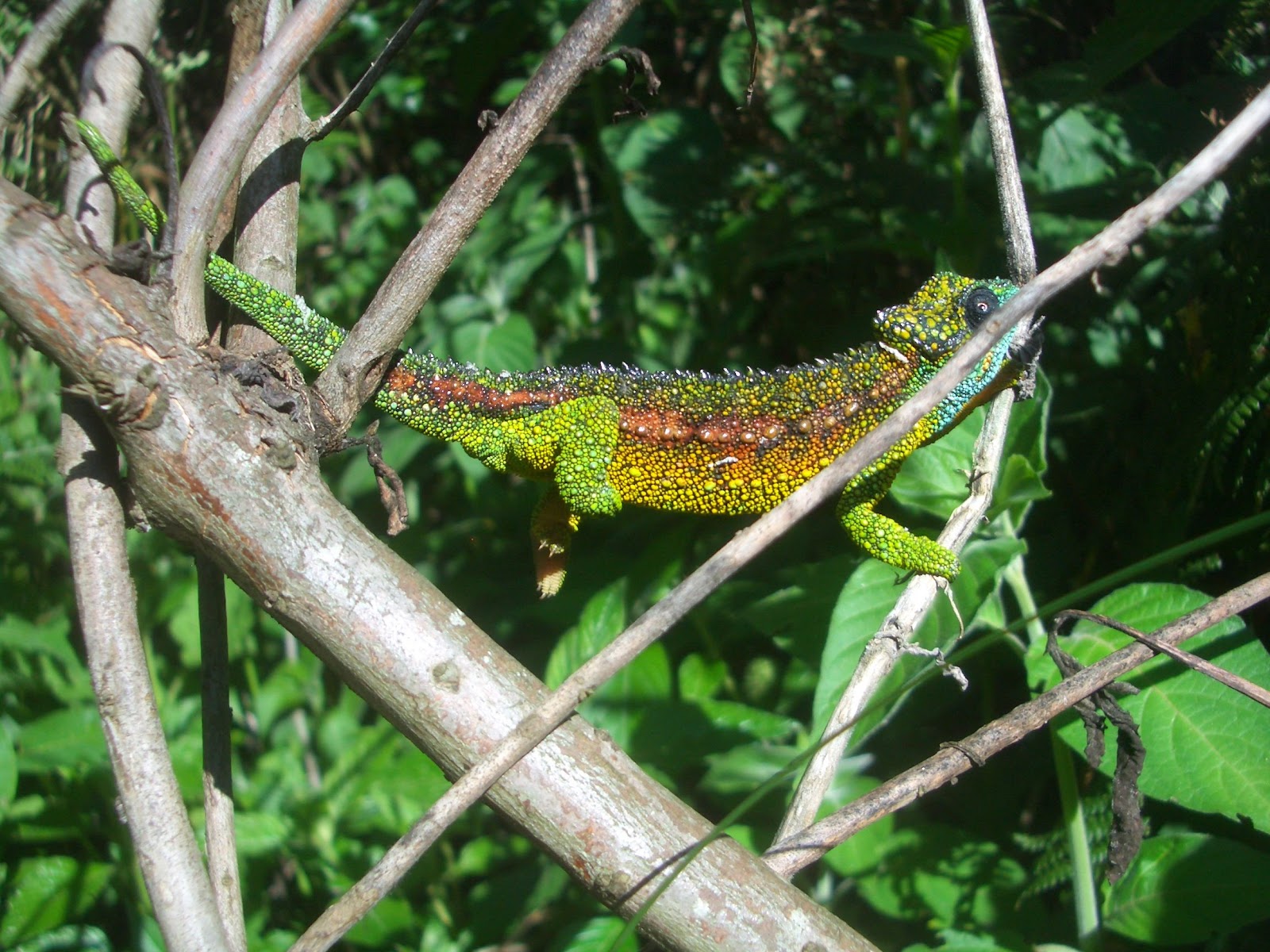
Chameleon living in the Nou forest
The Nou Forest offered Mom her first real night of camping; we had three 2-man tents (no concrete floors), two outside toilets, outside bush showers, and nothing else around except the forest and us.  Following our experiences at Tarangire, there was much expectation of leopards and hyenas visiting our camp during the night, given the feces identifications we had on our brief early evening hike.  The evening sky of Milky Way viewing was incomparable; the early night sky included Orion at our zenith, the Pleiades’, and a great viewing of the Magellenic clouds.  Enjoying the morning sunrise revealed that everyone had a deep night sleep and no stories of wild animal calls during the night.    
Karoli and Nana, but Karoli sure liked to say Kevin's name!


After breakfast Patrick, Roberta, Kevin and Bill followed Karoli off to the waterfalls, while Nana and Donna went with Charlie and Andreas to see Andreas’ house in the local village, where Andreas is the village chief.  Donna and Nana had a great time seeing Andreas’ house, family (son and granddaughter), farm and their cows and pigs.  Andrea took Nana and Donna over to see his Mom’s grave; she recently passed away after 87 years.    


Bill at Nou Forest Falls,  bat cave off to right
The trip to the waterfalls was a vigorous 6 km hike through the Nou Forest and was quite a challenge for all (except Karoli, who never seemed to break a sweat).  The ~100 foot waterfall was a welcomed sight and a refreshing foot relief.  There were lots of slippery rocks to crawl over, but the last few yards were worth it. 


Karoli beckoned us over to the main part of the falls to show us a cave.  Patrick and Kevin braved the scramble and followed Karoli deep into the cave.  Inside Karoli bounced up and down making pseudo baboon noises as Patrick and Kevin crawled in.  With a full jump up, Karoli stirred up the bats in the cave one hit Patrick on the way out, Kevin starts this big belly roll of a laugh, while outside the cave Roberta wonders, why are bats flying around in the daytime?  
Celebrating the days hike and victorious canasta card game.


An exhausted hiking crew and the village tour team spent the afternoon relaxing and later playing cards in the open-air mess tent.  It was a wonderful way to just enjoy the day and reflect on the travels of the last few days.